Computer science, human–computer interaction. Student @ Victoria University of Wellington.
I'm a student at Victoria University of Wellington studying a Bachelor of Design Innovation, majoring in interaction design and computer science with a minor in industrial design. Before university I spent several years in electrical trade work. I work across hardware, software and interaction design. This site is one example.
Moire, my earlier image-watermarking project, broke down on large images and had
little resilience to cropping or other image manipulation. Recent work on
watermarking prompted me to revisit those limitations. Its successor recovers an
embedded identifier after compression, cropping, and resizing, with visible grain
and recovery speed remaining areas for improvement.
Three models are relevant to those problems:
TrustMark, from Adobe Research and the University of Surrey, addresses
watermarking across image resolutions. Its ICCV 2025 publication follows the
original 2023 release. The model combines learned embedding and extraction with
error correction and resolution scaling. TrustMark paper and implementation
Pixel Seal, released by Meta in December 2025, examines visible artifacts
and the loss of quality and robustness when watermarking at higher resolutions.
Its design includes perceptual attenuation at the target resolution and training
that accounts for the resizing used during embedding. Pixel Seal paper
Watermark Anything, from Meta and published at ICLR 2025, locates marked
regions and extracts messages from them. This is relevant when a crop or
composite retains only part of the marked image. Watermark Anything model and paper
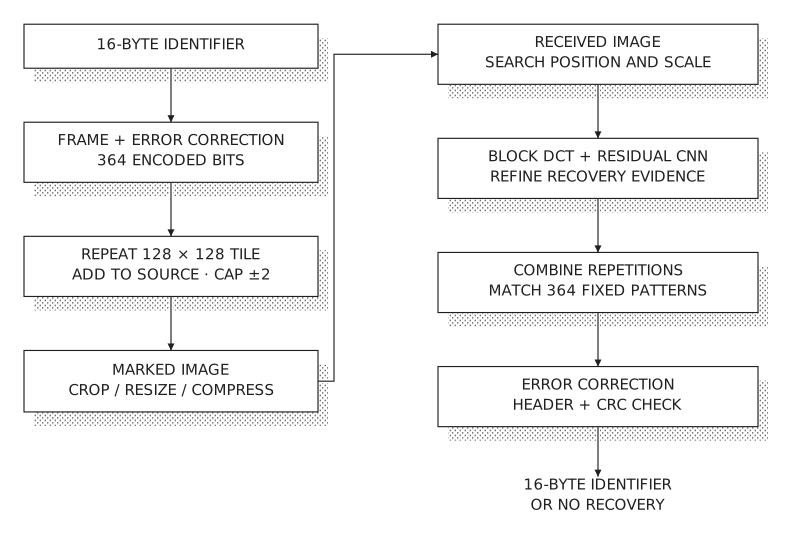
The system embeds a 16-byte identifier in an image’s pixels. The identifier can
be recovered without the original image, allowing a marked copy to carry a
reference to a separate record even when its file metadata is removed.
Figure 1. Embedding and recovery. The learned component operates during recovery;
the encoder uses fixed patterns and a bounded change to the source pixels.
The watermark consists of repeated patterns distributed across the image. These
patterns occupy selected frequency components in 8 × 8 pixel blocks and repeat
every 128 pixels. Larger images contain more repetitions, while the individual
pattern remains the same size. The 128 message bits are framed with a header and
checksum, then protected by a convolutional error-correcting code, producing 364
encoded bits. Each bit controls the sign of a fixed pattern. Their sum forms the
tile added across the image. Embedding changes each 8-bit colour channel by at
most two levels before any subsequent compression.
Cropping removes some repetitions and shifts the pattern’s origin. Resizing
changes its spacing. Recovery therefore begins by searching for plausible
positions and scales. At each candidate alignment, the decoder combines evidence
from corresponding positions in the surviving repetitions. A crop can preserve
enough evidence to recover the message even though part of the image is missing.
Further downsampling can remove that evidence as well as change its alignment.
The network works on the image’s frequency components. A discrete cosine
transform (DCT) describes the brightness variations within each 8 × 8 block using
64 coefficients. Eighteen of these coefficients occupy the band used for the
watermark. Limiting their magnitude prevents a few strong image features from
dominating the initial evidence.
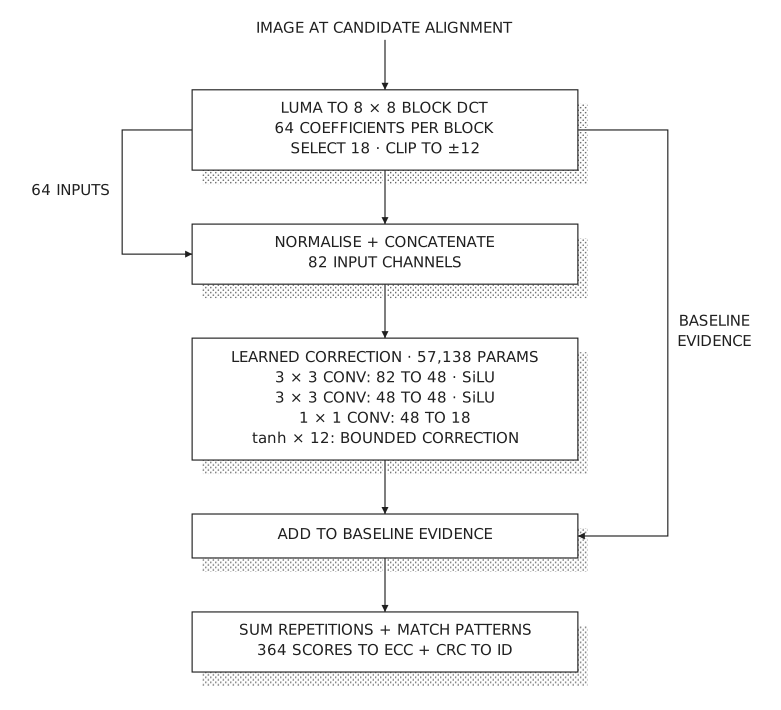
Figure 2. The residual decoder. The direct connection on the right preserves the
baseline evidence; the network adds a bounded correction. All channel counts
refer to features on the grid of 8 × 8 image blocks.
The network receives both the full set of DCT coefficients and the 18 selected
evidence channels. Two 3 × 3 convolution layers examine neighbouring blocks, and
a final 1 × 1 layer produces corrections for the 18 evidence channels. The
network has 57,138 learned parameters. Its output adjusts the measured evidence
without changing the received image or the fixed carrier patterns.
The corrected evidence is summed across repetitions and correlated with the
364 known patterns to produce bit scores. Error correction uses these scores to
recover a candidate message; its header and CRC checksum must then validate.
The decoder receives neither the original image nor the expected identifier.
Evaluation compares the recovered bytes with the embedded identifier and counts
only complete matches as successful recoveries.
In an evaluation using 100 photographs at a 1024-pixel long edge, the system
recovered the exact identifier in 699 of 700 trials. Each photograph was tested
in seven conditions. Crops retained 75% of the image area, resizing ranged from
65% to 125% of the marked dimensions, and framing added a uniform border.
Image condition
Exact recoveries
Unedited
100/100
JPEG quality 85
100/100
Cropped
100/100
Resized
100/100
Framed
100/100
Cropped, resized, and framed, saved as PNG
100/100
Cropped, resized, and framed, saved as JPEG quality 85
99/100
The remaining limitations concern image quality and processing time. Small pixel
changes can still produce visible grain in smooth or dark areas. Recovery is less
consistent after substantial downsampling. Recovering an identifier after resizing
requires a search over possible alignments, and rejecting an unmarked image can
be slow. Further work can focus on reducing
visible changes in sensitive regions and shortening that search while preserving
exact recovery.